Wednesday, 1 August 2018

Belfast - Titanic Design

Titanic Hotel Belfast
Titanic Model
 The Titanic would be 289 metres  (883 feet) long, 28 metres (93 feet) wide, and 18 metres (59 feet) high from the waterline. The structure would consist of 8 decks above a double bottom and the vessel would have four funnels. The ship would weigh over 46,000 tons.

Titanic could carry 3,547 passengers and crew.
 
 
The ship would be powered by two reciprocating four-cylinder, triple-expansion steam engines and one low-pressure Parsons turbine, which powered three propellers. This would give Titanic a top speed of 23 knots (43 kmh; 26 mph)To drive the engines there would be 29 boilers fired by 159 coal burning furnaces. The ship had three functional funnels, the fourth was to make the ship look more impressive than her rivals.


Titanic would have eight main decks built on a double plated bottom, and topped by the boat deck.

 The ship would be traversed by 15 major traverse bulkheads dividing the vessel into 16 watertight compartments. The front two bulkheads rose to the level of D deck, the remainder reached to E deck. 

The watertight compartments had doors that would close automatically if the water level reached a certain height. The ship was designed so that it could remain afloat if any two of the compartments were flooded or if the first four were flooded.


The decks consisted of:


     Boat Deck
A- Promenade Deck
B- Bridge Deck
C- Shelter Deck
D- Saloon Deck
E- Upper Deck
F- Middle Deck
G- Lower Deck
     Orlop Deck
     Tank Top


Sunday, 1 July 2018

Belfast - Titanic Keel Laying

On the 31st March 1909 the keel of Titanic was laid. A monument on the Titanic Slipway Belfast commemorates the laying of the first plate.

Titanic Slipway Belfast
Titanic Keel Laying Commemoration
 
Titanic Slipway Belfast
 IJ Titanic Keel Laying Commemoration

Harland and Wolf Belfast
Titanic Keel 1909


Friday, 1 June 2018

Belfast - Titanic Hull Construction

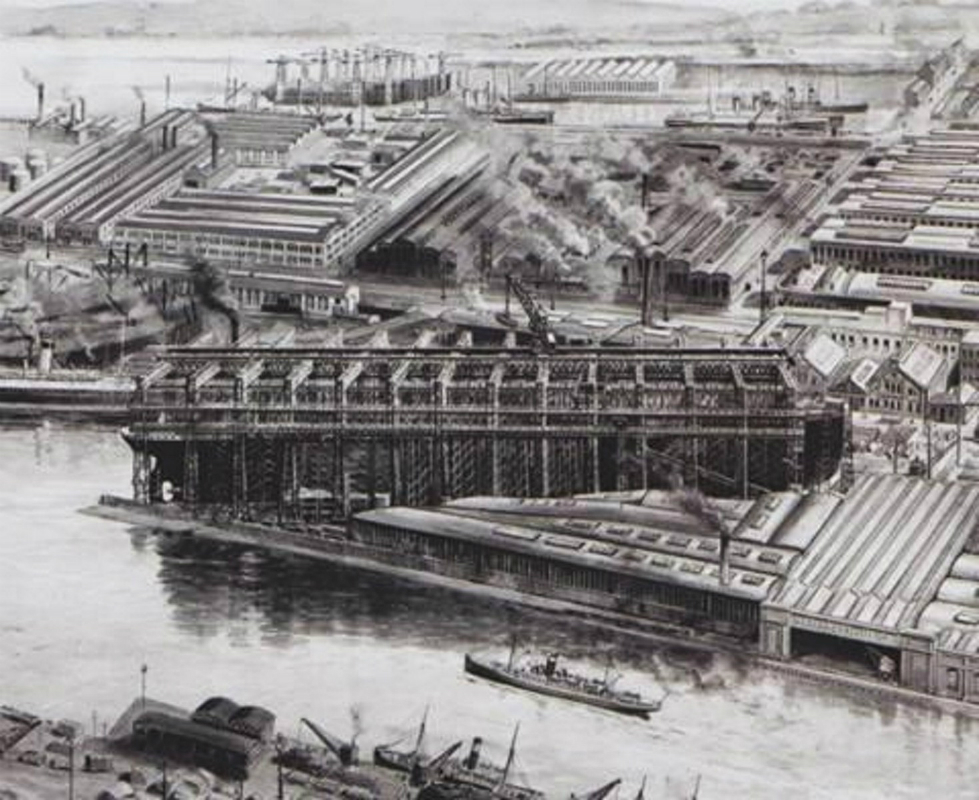
The two Olympic Class ships, Olympic and Titanic would be built alongside side each other at Harland and Wolf Belfast Shipyard.


The shipyard numbers allocated were Olympic (400) and Titanic (401). Their hulls would be constructed under the giant Arrol Gantries on slipways 2 and 3.

Harland & Wolf Belfast Slipways 2 and 3


The keel of the Olympic as laid on the 16th December 1908 and by the time the Titanic's keel was laid on 31st March 1909 the double bottom was complete.

The keel consisted of steel plates  3.8cm (1.5 ins) thick, reducing to 3.0 cm (1.2 ins) thick at bow and stern. The keel plates were 132 cm (52cms) wide at their broadest point. Below the keel a 50cm (19.5 ins) 7.6 cm (3 ins) slab bar was added for additional protection.

Laying of the Titanic
Once the keel was laid the next stage was the construction of a double bottom, 160 cm (63 ins) deep at the centreline and 190 cm (75 inches) in the area of the Reciprocating Boiler Room.

The inner bottom (Tank Top) extended from the first major watertight bulkhead, A, to 6 metres (20 feet) in front of bulkhead P, the last major watertight bulkhead before the stern. The longitudinal and lateral girders created a series of 44 water tight cells.
 
Titanic's double bottom
On the 10th January 1910 the next stage of Titanic's construction, the assembly of the frame work, commenced. Tree hundred steel ribs were bent to the required shape and lowered individually into place.


Working on the double bottom
Framing the Titanic


Titanic framing in progress
The chairman of the White Star Line, Bruce Ismay visited the Belfast Works to inspect the progress on the construction of the two Olympic Class ships. He and Lord Pirrie would have seen Olympic almost fully plated and Titanic's framing nearing completion.
 
Lord Pirrie and Bruce Ismay Belfast Works 19th March 1910

Titanic framing in progress
By the 9th April 1910 Titanic was fully framed so plating could commence.  

Titanic framed - Olympic plated
 The steel  plates used on the Titanic 's shell were generally 9.1 metres (30 feet) long, 1.8 metres (6 feet) wide, the thickness varying between 2.5 cm (1 inch) and 3.8 cm (1.5 inches) thick. They weighted 2.5 to 3 tons. The largest steel plates were 11 metres (36 feet ) in length and weighed 4.5 tons.
 
Over 2,000 plates would be used for Titanic's outer skin. Three million rivets were used to hold the plates together. The rivets were heated, placed through holes in the steel plates and hammered together. Hydraulic machines were used for riveting, however at the bow and stern there was no room for the machines and riveting was done by hand.
 
Titanic being plated by hydraulic riveting machine
 
Titanic being plated by hand riveting


Titanic plated - Olympic ready to launch
The plating of the Titanic's hull was completed on the 19 October1910. The following day the Olympic was launched.

Launching of the Olympic 20th October 1910

Titanic after launching of the Olympic
Titanic's hull was completed in May 1911. From the laying of the keel to the hull being completed it had taken  792 days,  2 years, 2 months and 1 day.

Titanic prior to its launch

Titanic - Launch day


Tuesday, 1 May 2018

Belfast - Titanic Launch


On May 31st 1911 Titanic was launched at the Harland and Wolf Shipyard in Belfast.

It had taken 792 days  to complete the construction of her hull, 2 years, 2 months and 1 day after the keel was laid on 31st March 1909. Her sister ship Olympic had been launched 6 months earlier on 20th October 1910. Twenty tons of soft soap and oil had been applied to the slipway to aid the ship to enter the water of the River Lagan.

To witness the launch, dignitaries were invited to view proceedings from a specially constructed grandstand. Amongst those present were JP Morgan, head of the International Mercantile Marine Company (the owners of White Star Line); J Bruce Ismay, Chairman White Star Line; and the Lord Mayor of Belfast. Almost 100 journalists had travelled to Belfast (many on a specially charted steamer, the Duke of Argyll) to record the launch and were provided with a grandstand. A further two grand stands were built for ticket holders who had purchased their places, the funds going to local Belfast Hospitals. 
 

Just after noon a red signal rocket was fired and red flags raised to signify the launch was imminent. The White Star Line did not go in for ceremony, there would be no naming of the ship, no champagne breaking on the ships bow, and no ceremony. At 12:13 a second red rocket signalled the start of the launch. Lord Pierre, chairman of Harland and Wolf gave the order and the last remaining timber supports were removed and Titanic started to slip into the water. One minute later she was in the River Lagan.


River Lagan Belfast into which the Titanic was launched.

Her launch weight was recorded at 24,360-tons. Once launched Titanic was towed to a dry dock to start fitting out.


******


******

Thursday, 1 December 2016

London - Oceanic House - Maiden Voyage

White Star's London Office , Oceanic House, was situated in Cockspur Street near to Trafalgar Square. Oceanic House was constructed between 1903 and 1906, the prestigious area being the location of rival companies, Cunard, P & O and Hamburg American Line.

Oceanic House 1 Cockspur Street London
Oceanic House White Star Line London Office
Oceanic House White Star Line London Office Ticket Office
Tickets for Titanic's maiden voyage to New York could be purchased at the London Ticket Office. The cost of a Third Class ticket in 1912 was 7 pounds 9 shillings and zero pennies, A skilled mans wage in 1912 was £100. The value of a ticket, £7.45. is equivalent to £594. 95 today.


Oceanic House White Star Line London Office Ticket Office
Titanic Third Class Ticket
Oceanic House in 2019 is a Grade II listed building which was converted into a luxury apartment block in 2017.
Oceanic House 1 Cockspur Street London