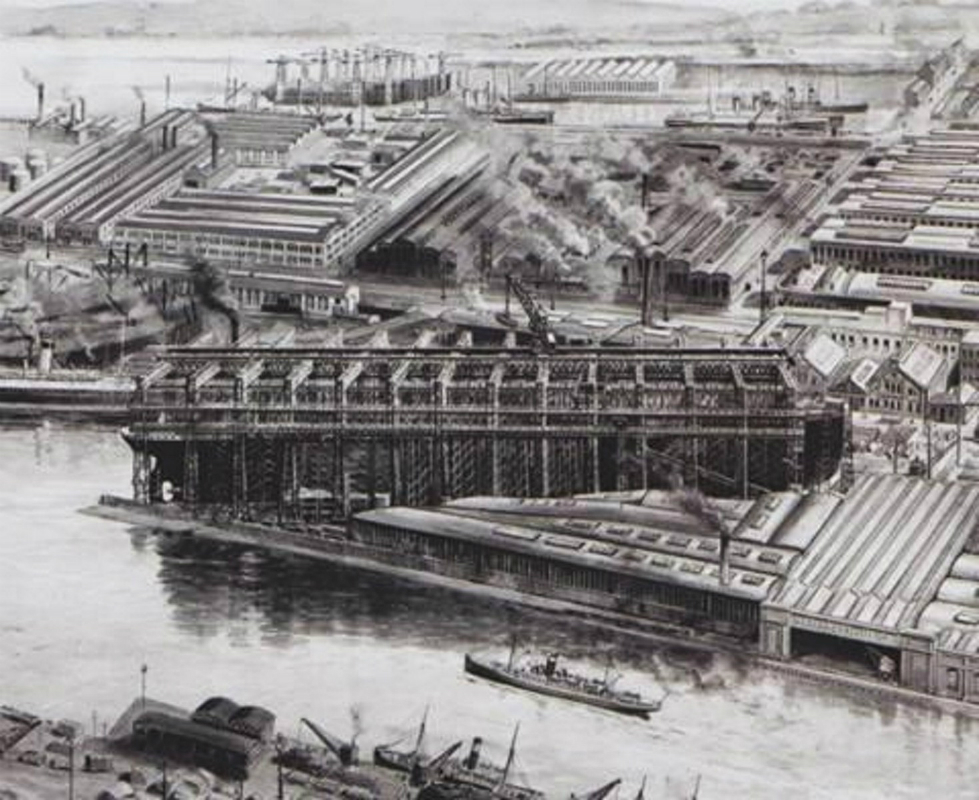
The two Olympic Class ships, Olympic and Titanic would be built alongside side each other at Harland and Wolf Belfast Shipyard.
The shipyard numbers allocated were Olympic (400) and Titanic (401). Their hulls would be constructed under the giant Arrol Gantries on slipways 2 and 3.
 |
| Harland & Wolf Belfast Slipways 2 and 3 |
 The keel of the Olympic as laid on the 16th December 1908 and by the time the Titanic's keel was laid on 31st March 1909 the double bottom was complete.
The keel consisted of steel plates 3.8cm (1.5 ins) thick, reducing to 3.0 cm (1.2 ins) thick at bow and stern. The keel plates were 132 cm (52cms) wide at their broadest point. Below the keel a 50cm (19.5 ins) 7.6 cm (3 ins) slab bar was added for additional protection.
The keel of the Olympic as laid on the 16th December 1908 and by the time the Titanic's keel was laid on 31st March 1909 the double bottom was complete.
The keel consisted of steel plates 3.8cm (1.5 ins) thick, reducing to 3.0 cm (1.2 ins) thick at bow and stern. The keel plates were 132 cm (52cms) wide at their broadest point. Below the keel a 50cm (19.5 ins) 7.6 cm (3 ins) slab bar was added for additional protection.
 |
| Laying of the Titanic |
Once the keel was laid the next stage was the construction of a double bottom, 160 cm (63 ins) deep at the centreline and 190 cm (75 inches) in the area of the Reciprocating Boiler Room.
The inner bottom (Tank Top) extended from the first major watertight bulkhead, A, to 6 metres (20 feet) in front of bulkhead P, the last major watertight bulkhead before the stern. The longitudinal and lateral girders created a series of 44 water tight cells.
 |
| Titanic's double bottom |
On the 10th January 1910 the next stage of Titanic's construction, the assembly of the frame work, commenced. Tree hundred steel ribs were bent to the required shape and lowered individually into place.
 |
| Working on the double bottom |
 |
| Framing the Titanic |
 |
| Titanic framing in progress |
The chairman of the White Star Line, Bruce Ismay visited the Belfast Works to inspect the progress on the construction of the two Olympic Class ships. He and Lord Pirrie would have seen Olympic almost fully plated and Titanic's framing nearing completion.
 |
| Lord Pirrie and Bruce Ismay Belfast Works 19th March 1910 |
 |
| Titanic framing in progress |
By the 9th April 1910 Titanic was fully framed so plating could commence.
 |
| Titanic framed - Olympic plated |
The steel plates used on the Titanic 's shell were generally 9.1 metres (30 feet) long, 1.8 metres (6 feet) wide, the thickness varying between 2.5 cm (1 inch) and 3.8 cm (1.5 inches) thick. They weighted 2.5 to 3 tons. The largest steel plates were 11 metres (36 feet ) in length and weighed 4.5 tons.
Over 2,000 plates would be used for Titanic's outer skin. Three million rivets were used to hold the plates together. The rivets were heated, placed through holes in the steel plates and hammered together. Hydraulic machines were used for riveting, however at the bow and stern there was no room for the machines and riveting was done by hand.
 |
| Titanic being plated by hydraulic riveting machine |
 |
| Titanic being plated by hand riveting |
 |
| Titanic plated - Olympic ready to launch |
The plating of the Titanic's hull was completed on the 19 October1910. The following day the Olympic was launched.
 |
| Launching of the Olympic 20th October 1910 |
 |
| Titanic after launching of the Olympic |
Titanic's hull was completed in May 1911. From the laying of the keel to the hull being completed it had taken 792 days, 2 years, 2 months and 1 day.
 |
| Titanic prior to its launch |
 |
| Titanic - Launch day |